


Everest Base Camp Trek – 14 Days
5/5 based on 05 reviews

Trip Duration
14 Days
Group Sizes
Min- 2
Transportation
Cars & Flights
Destination
Nepal
Max. Altitude
5550m
Best Season
March-May & Sep-Dec
Activities
Trekking/Hiking

Difficulty
Moderate
Meals
B.L.D.

Start & End Point
KTM To KTM
Accommodation
Hotel & lodge
Welcome to one of the world’s most beautiful trekking tours at the foot of the world’s highest mountain! There are not many trekking tours in the world, if any, that beat the Everest base camp trek, which will take you through the amazing Khumbu Valley and the Icefall of the same name. Through this trek, you will experience the most beautiful facets of Nepal and perhaps the most beautiful alpine highlands.
Everest base camp is situated in the Sagarmatha (Everest) National Park of Solukhumbu region in the eastern part of Nepal at an elevation of 5364 m. This base camp is also known as the South Everest Base Camp, and the one on the Tibetan side is known as the North Base Camp.
The south Everest Base Camp has been privileged with the footprints imprinted by legendary Edmund Hilary and Tenzing Norgay in 1953. Since then, legendary trekkers and climbers have rested at Everest Base Camp as an acclimatization destination before climbing the mighty Everest, including the TV Icon Bear Grylls.
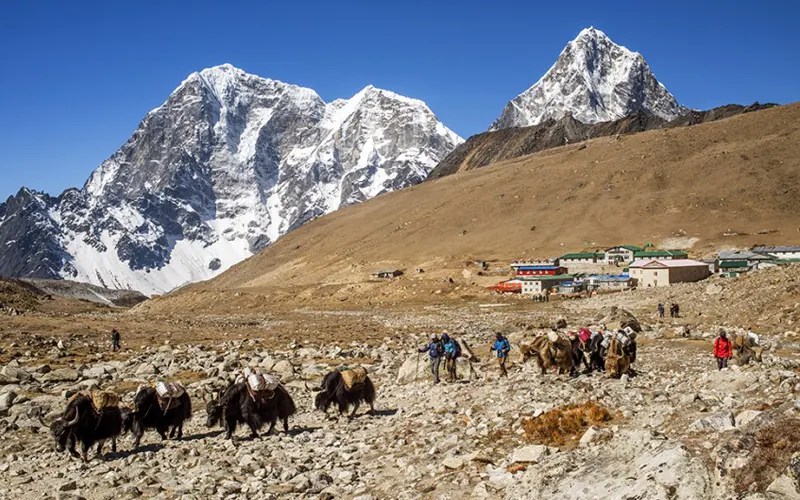
Regarding our 14-day Everest Base Camp journey, you will experience exceptional natural beauty, including majestic mountain landscapes, rushing rivers, lush pine, and beautiful rhododendron forests. You will cross suspension bridges over the gurgling rivers of Dudh Koshi, Bhote Koshi, and Imja Khola and overcome challenging climbs and winding paths that take you through Sherpa villages, where you can experience the unique local culture and hospitality.
These people follow ancient Tibetan Buddhism and practice agriculture, yak, and sheep herding, along with dedication to the Tourism industry as lodge owners, mountain climbing and trekking guides and porters.
Highlights of the tour include Namche Bazaar, a bustling trading town where you can experience Sherpa culture and enjoy stunning mountain views. Tengboche Monastery, a spiritual center where you can participate in Buddhist ceremonies and admire breathtaking views of Everest and nearby peaks.
Nagarjun Hill, which you can climb when resting in Dingboche, offers unique views of Makalu, Baruntse, Island Peak, Chopola, Amadablam, Ambigetshen, Thamsherku, Khankaru, Tabuche, Cholatse, Lobuche Peak, and Nirukhang.
And, of course, Everest Base Camp itself, where you can stand at the foot of the impressive mountain range and feel its unparalleled beauty and power.
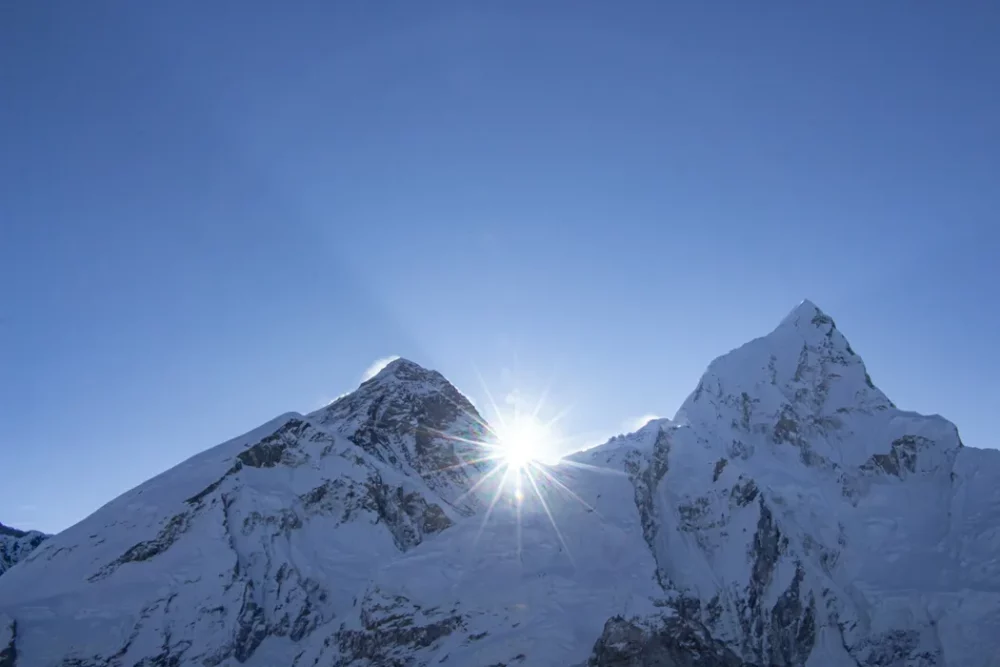
However, the most challenging yet rewarding highlight will be a climb to Kala Patthar at a respectable altitude of 5,548 m. Here, you will witness the most beautiful sunrise over Mount Everest, Ama Dablam, Kangtega, Thamserku, Pumori, Lhotse, Nuptse, Amadablam, Lobuche, Lingtren and many more.
Our 14-day Everest Base Camp trek is a beginner-friendly trekking program that requires good physical fitness as you will be exposed to high altitudes and challenging terrain. We offer you appropriate equipment, an experienced guide, and a thoughtfully planned itinerary to ensure your safety and the best possible experience.
Overall, the Everest Base Camp trek is an impressive journey that allows you to get up close to the unique beauty of the Himalayas, challenge your own limits, and experience a unique cultural heritage. It is a dream for many adventurous souls and an opportunity to deposit everlasing moment in your memory bank.
Our Everest Base Camp journey begins with a thrilling flight to Lukla, from where we trek to Phakding, Namche Bazaar, Tengboche, Dingbche, and Lobuche. The following day, we reach Gorskhep, from where we ascend to Everest Base Camp.
The next day’s climb will lead us to the top of Kala Patthar, from where we descend to Pheriche, Namche, and Lukla.
Namaste and Tashi Delek to Kathmandu! After your landing at TIA, our local guide, after a wonderful reception, will drive you to the hotel in Kathmandu.
After your arrival and rest, our guide will meet you and will organize a group meeting where each fellow traveler will be introduced to each other. He will also explain our itinerary regarding the Everest Base Camp trek of 14 days.
During the evening, we will review our equipment to ensure everyone has what is needed. If necessary, our guide will help rent/buy missing equipment.


We will depart from Kathmandu early in the morning and go to Lukla. The mountain flight into Lukla is spectacular, with beautiful views of Everest and Kanchenjunga. The landing is also an exciting beginning to the trek as Mount Kongde Ri (6187 m) greets us at the legendary Tenzing Hilary Airport.
We will meet our local Sherpa team and share our luggage with them. Then, after lunch, we will start our hike towards the base of the world’s highest mountain. Our first hike will be short, easy, and beautiful along the path lined with ornately carved stone slabs with Buddhist prayers.
Moving along the Dudh Koshi River, as we reach the border of Lukla Village, our guide will obtain the Sagarmatha National Park and Khumbu rural municipality permits for us. Then, we will wind down through the pine forest via Chheplung, Chaurikharka, and Thadokoshi. A brief pause will give us a glimpse of Mount Kusum Kangaru (6367m).
We will now climb down towards Ghat Village, mesmerized by the astounding view of Mount Khumbila (5761 m). eventually, Phakding will greet us in the late afternoon.
Attention
Direct flights to Lukla from Kathmandu may get canceled due to high air traffic load, especially in the Spring and Autumn months. In such case, we will not wait for the next day’s flight but drive towards Ramechhap/Manthali Airport, from where we will fly to Lukla. The flight duration from here is only 20 minutes.
After reviving tea and breakfast in the morning, we pack our bags and head along the Dudh Koshi River, enjoying the magical view of Thamserku mountain (6609 m). The trail with the pine and rhododendron forest leads us to Benkar and Monjo Village, where we come to Sagarmatha (Everest) National Park itself. After a short climb onward, we will reach Jorsalle village, where we will pause for lunch.
A short, gentle hike of about 30-40 minutes from the Park will lead us to the junction of two rivers: Imja Drangpa and Nangpo Tsangpo (Bhote Koshi), which we will cross by walking over a Hilary Suspension bridge. The iconic bridge offers us an incredible view of Mount Taboche at 6495 m.
An hour’s hike from the bridge, and we will arrive at Topdanda (3140 m), aka Everest View Point. It is the best viewpoint from which to enjoy the magical panorama of Everest, Lhotse, Nuptse, and many more.
Another one hour steep climb and we will arrive at Namche Bazaar. It is a very prosperous Sherpa town and an important trading center for the area. It is here we will see for the first time the grandeur of Mount Everest along with Thamserku, Kangtega, Nuptse, and Lhotse.
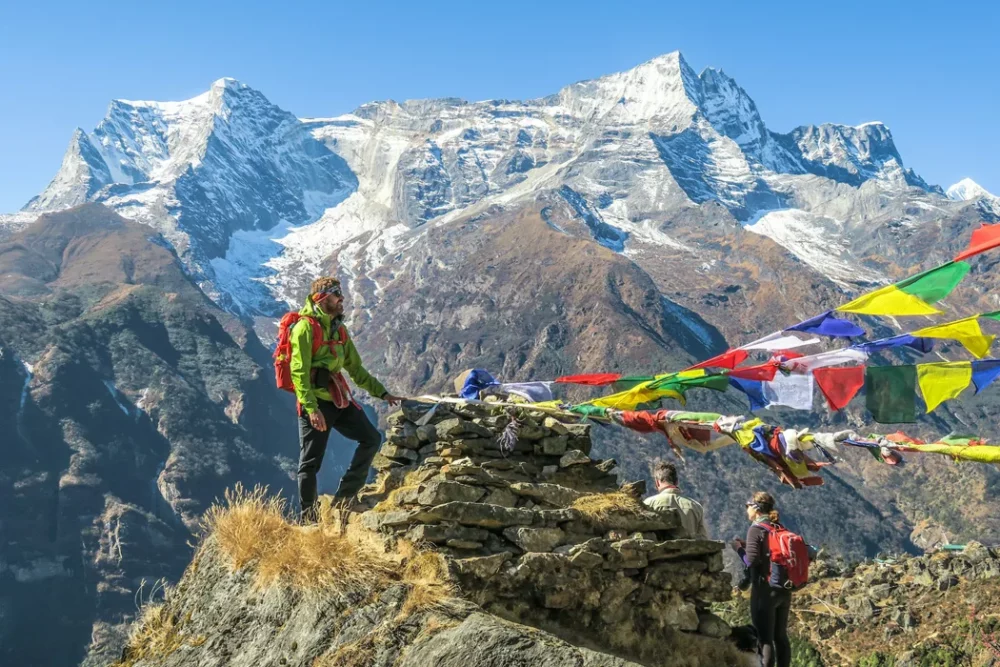
We will march up to the Everest View Hotel at 3880 m today to get used to the thin air. It is considered the tallest hotel in the world. A two-hour uphill walk will lead us to the Hotel, and the trail offers the magnificent spectacle of Kongde ri, Khangtega, Pachermo Peak, Tangerito Peak, Samdur Peak, and many more.
The Hotel terrace is like an arena where the Great Himalayan Giants of Everest, Ama Dablam, Thamserku, Lhotse, Taboche, Cholatse, and Nuptse will surround us.
After enjoying our breakfast in the hotel, we will climb down to Namche, walk around, and enjoy the atmosphere of the village and its crowds.
After enjoying a hearty breakfast at Namche, we will resume our walk towards Tengboche. It is an easy hike for an hour, and then it is downhill for an hour and a half. Then, we will cross the hanging bridge and continue walking through the pine, fir, and rhododendron forest to reach Phungithanga at 3250 m.
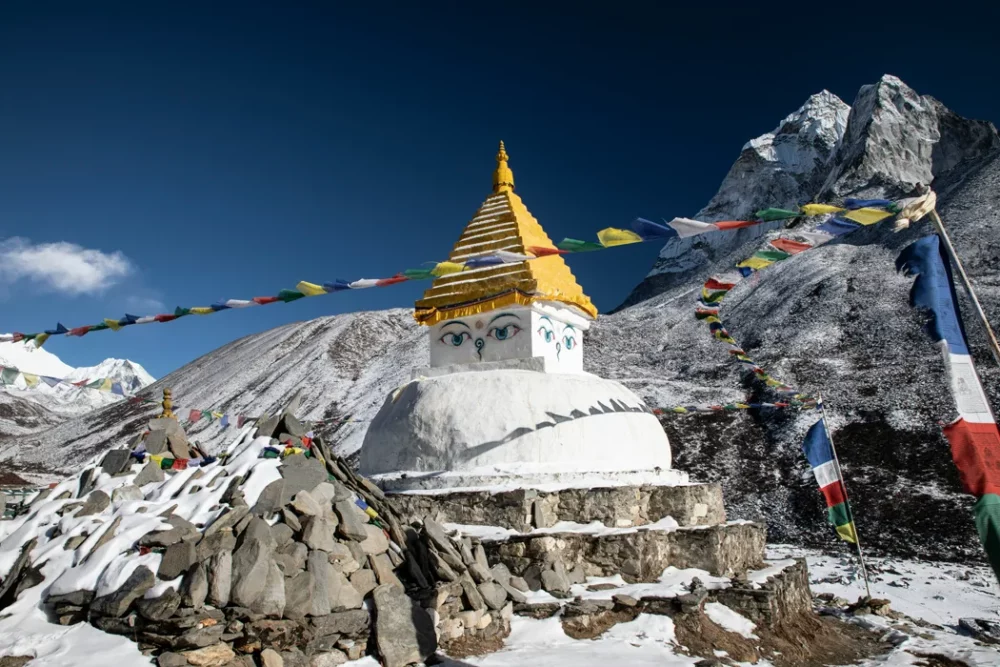
We will take a break for lunch here, marveling at the rotating prayer wheels and the surrounding Peaks. It is now an uphill trek for about two hours till we reach the plain of Tengboche Gumpa. It is the most important monastery of the Sherpa people and the center of Buddhism in this area.
The monastery is also the important viewpoint from where we can witness the magical wonder of Everest, Nuptse, Lhotse (8,501 m), Kwangde (6,187 m), Tawachee (6,542 m), Ama Dablam, Kantega, and Thamserku.
We will now descend to our lodge in the village to spend the night.
Today awaits a pleasant and gradual ascent in the terrain through forest and colorful rhododendron bushes. We will climb for a while towards Debuche, along the trail, enjoying the beautiful view of the gorgeous mountain Ama Dablam.
We will now climb down and cross the Imja Khola and reach Pangbcohe. The village is known as a 400-year-old monastery where Yeti scalp have been stored.
From the village, we will trek uphill for a while, and the potato and barley fields of Dingboche will be shortly on the horizon.
We have added a rest day here as you are now up at really high altitudes. You can either stay in place, rest, and enjoy the view over Ama Dablam, Kantega, and Nuptse. Or do a day hike to climb Nangkartshang Hill (Nagarjun Hill ) at 5100 m.
It is the best vantage point to see the illuminating peaks of Makalu, Baruntse, Island Peak, Chopola, Amadablam, Ambigetshen, Thamsherku, Khankaru, Tabuche, Cholatse, Lobuche Peak, and Nirukhang.
After some time, we will return to our lodge and rest for the night.
Today, we will follow the valley where you can enjoy the view of the two impressive mountain peaks, Cholatse (6335 m) and Tawache (6367 m). We will climb upward and reach the yak pasture of Dusa. Here, we will cross a hanging bridge and arrive at Dughla, where we will pause for our lunch.
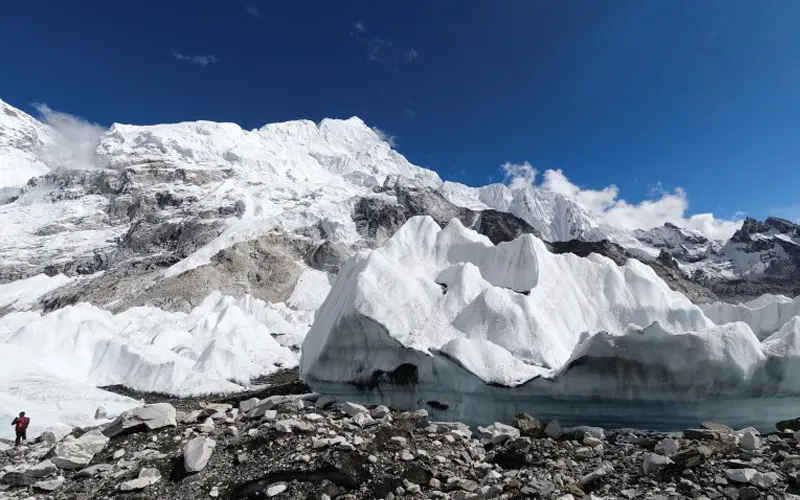
We will now hike up towards the Khumbu Glacier, and after about an hour-long vertical climb, we will be at Thuk La Pass at 4830 m. here, we will meet many cairns set up in memory of Sherpas who lost their own lives while trying to help others reach the top of Mt. Everest.
We will also offer our prayers for the deceased souls and witness the magical views of Ama Dablam, Lobuche, and Lobuche Peak Base Camp. Now, we will leave the Khumbu Glacier and reach Lobuche.
Early morning, with 3 hours hard but beautiful trek along Khumba Glacier towards Gorak Shep. The route provides us with some wonderful views of Everest, Pumori, Mahalangur, Lingtren, Khumbutse, Nuptse, and other peaks.
A short ascent will lead us to Thangma Riju or Lobuche Pass, which bestows us a 360-degree view of snowy peaks. From here, a vertical climb along the Changri Glacier will give us glimpses of Kala Patthar, a black hill at the base of the Pumori peak.
We have now reached the Gorak Shep village, which is the last village along the Everest trail. Here, we will take some well-deserved rest to continue moving towards Everest Base Camp.
After rest, we will leave our backpacks here and walk via the once-great Gorak Shep Lake. Then, a steep climb along the ridge and we will be at the Everest Base Camp, which offers the magnanimous panorama of Nuptse, Lhotse, Khumbutse, and Pumori.
After visiting these high altitudes, we turn the steps down towards Gorakshep again.
Another early morning for trekking to one of the absolute most beautiful viewpoints to be found in the Everest region: Kala Patthar. The ascending route offers remarkable views of Lingtren, Khumbutse, and Changtse.
We will be on time at the top of the Kala Patthar to witness the golden hues of the rising sun over the Everest, Lhotse, Nuptse, Amadablam, Lobuche, Pumori, Lingtren, Khumbutse, Changtse, and many others.
We will take some pictures, make some videos, and immerse ourselves in the beauty of Mother Nature. Then, we will hike back to Gorak Shep, where breakfast awaits us. After the meal, our hike continues, mostly downhill, to Lobuche, Dughla, and then on to Pheriche.
In Pheriche, the HRA (Himalayan Rescue Association) has a rescue center for injured hikers and mountaineers, which is really interesting to visit.
From today, we have mostly downhill hike till we reach Namche Bazaar, from where we will make our way back to Kathmandu. After breakfast, we will leave Pheriche and hike down Pangbcohe. Along the way, we will pass many hikers on their way up, and we wish them luck while enjoying the details of the surroundings now that our steps and breathing feel easier.
We will now walk past the familiar Sherpa settlements of Deboche, Tengboche, and Phungi Thenga to reach Namche Bazaar.
It is surprisingly easy to hike down to the village of Jorsalle from Namche Bazaar. We will then follow the road past the small villages of Monjo, Benkar, Phakding, Thadokoshi, Chaurikhark, and Chheplung to reach Lukla.
Early in the morning, our flight goes back to Kathmandu, a flight of about 35 minutes, and if the weather is clear, the view is formidable. From TIA, we will drive you to your hotel, where you can relax and rejoice in the adventure you have just completed.
Today, it’s heading home. We will transfer you to TIA depending on your flight times.


Autumn (September to November) is the best time and the most popular season for the Everest Base Camp trek in Nepal. The weather is mostly clear and sunny, and the temperatures are mild, ranging between 6 to 22°C. The temperature may drop to 2 to -5°C at night in the Khumbu region and at Everest Base Camp. The downside is that there are more hikers, and the teahouses along the popular trails are usually full of tourists.
Spring (March to May) is another popular time for Everest Base Camp trekking. During this time of year, the snow in the mountains begins to melt in the mild climate, and rhododendron bushes begin to bloom. The temperature in the Khumbu region often ranges between 14°C to -10°C during the day and below freezing point at night.
The disadvantage of traveling during this period is that the weather is not as clear as in autumn, which means that clouds can hide the views of the mountain ranges.
The low season of Summer/Monsoon (June to August) and winter (December to February) are more favorable for experienced and well-trained hikers who can overcome the challenges of bone-chilling temperatures and unexpected storms of winter and risks of landslides in summer.
The iconic Everest Base Camp stands proudly in the Sagarmatha National Park at an elevation of 5364 m above sea level. This extraordinary destination, alluring daring adventurists for years, lies at a distance of 200 to 300 km away from Kathmandu.
Kala Patthar at 5548 m marks the highest elevation of our 14-day Everest Base Camp Trek, while the elevation of 5180 m of Gorakshep will be the maximum elevation of our overnight destination.
Our Everest Base Camp trek of 14 days begins from the Sherpa town of Lukla, elevated at a respectable altitude of 2800 m. The town is at an aerial distance of 135 km from Kathmandu and can be covered within half an hour’s flight. From Lukla, the impressive Everest Base Camp is just 65 km away and takes around 11 days to journey on foot, walking 10 to 15 km.
During our 14-day expedition to Everest Base Camp, we will hike for 11 days, walking for 5 to 6 hours on average. The walking duration of every day has been planned with deliberate attention to acclimatization. Therefore, most of our walks will be steady, slow, and gradual.
However, the easiest walk is on the second day as we hike from Lukla to Phakding along the easy yet beautiful route and reach the village within three hours.
The most challenging part of our Everest base Camp trek will be on the ninth and tenth days. On the ninth day, we ascend from Lobuche to Gorak Shep and set foot at Everest Base Camp, then return back to Gorak Shep taking us about 6 to 7 hours of journey on foot.
The next day, we climb Kala Patthar and climb down to Pheriche, which will take approximately 7 hours to complete.
The 14-day Everest Base Camp trek is classified as a moderately challenging trek in the Khumbu region of Nepal. The 11 hiking days on this trek don’t require any technical skill, special gear, or previous experience of high altitude trekking or climbing. The trail is mostly easy along the stony paths from lush to barren landscape.
You have to tackle broad scree along the path after Namche Bazaar, while from Lobuche, you will have to overcome low-angled snow ridges at angles up to 30 degrees.
Therefore, very good fitness and hiking skills are required. We have two acclimatization days on the way with a thoughtfully designed itinerary and walking hours for gradual adaptation to the high altitude thin air.
There is also the possibility of a health check at the Himalayan Rescue Association medical station along the way.
If you are a fit individual who enjoys sound physical and mental well-being, then the Everest Base Camp trek is for you regardless of your experience level. However, keep in mind that during the 14-day trek, you have to overcome steep inclines, challenging mountain terrain, lengthy suspension bridges, and dense forests. Therefore, a good level of endurance and strength is a prerequisite for the trek.
We suggest you do not hurry and distribute your energy carefully with steady walks. Adaptability, flexibility, and endurance play a crucial role in this trek than your physical strength.
We are passionate about providing you with a comfortable journey to Everest Base Camp. Therefore, our experienced and certified English-speaking guide will accompany you throughout the tour and will keep a comfortable pace that suits the whole group. We will stop at regular intervals to eat, drink, and take the opportunity to take photographs.
You do not need to have previous experience of trekking to do this trek. However, it is important that you train at home in preparation for the Everest base camp trek. An excellent exercise is putting on your backpack and going outside for a nature walk. Preferably on good slopes as you train the muscles in the parts of the body required for the hike.
You should expect 4-6 hours of hiking most days, and some days it will be 6-8 hours of hiking. We recommend that you use hiking poles during the trek, so feel free to use these during training as well.
Running, walking, swimming, or cycling will also help you build strength and endurance. Please do not overexercise; keep it at a medium level, limiting it to three times a week.
Multiple routes are available to reach Everest Base Camp, each with its unique feature and difficulty level. You can follow the classic route to Everest Base Camp from Lukla to Gorakshep for a comfortable and luxurious trek. After climbing Kala Patthar, you can then ride in a helicopter to return to Lukla.
The other option is a one-day helicopter tour of Everest Base Camp with a stopover at Kala Patthar and Hotel Everest View. This program is designed for those who are short of time or have some health issues but still want to see Everest with their own eyes. This is relatively the most expensive option for seeing Mother of all Mountains.
On the other hand, if you are an adventure freak, then you can follow the footprints of Tenzing and Hilary and trek from Jiri to Phakding, adding a few more trek days through the much more remote setting of Nepal.
You can also integrate some other extraordinary Khumbu destinations with the Everest Base Camp trek. Such as the Gokyo Lake trip, the Three Passes trek, or the Tashi Lapcha Pass trek.
For experienced trekkers who wish to heighten their experience and thrill, you can climb Lobuche or Island Peak when trekking to Everest Base Camp.
Altitude sickness is the primary concern in the Everest Base Camp trek due to the differences in altitude as you transition from 1350 m of Kathmandu to 2800 m of Lukla within a day. The trek days ahead will lead you to the high-mountain villages of Tengboche, Dingboche, and Lobuche.
When you reach Everest Base Camp and climb the Kala Patthar, you will be well above 5000 m. therefore, you are likely to experience the symptoms of altitude sickness due to thin air. Hiking in these conditions is, therefore, a challenge for the body, which, in many cases, hikers see as part of the allure.
The common experiences most hikers go through are headache, dizziness, vomiting, nausea, shortness of breath, and loss of sleep and appetite. The best tips to minimize altitude sickness are to:
In order to reduce symptoms quickly, you can take the Diuretic drug Diamox, which can relieve your condition within a few hours.
We are very passionate about facilitating each of our guests with outstanding hospitality and utmost care during the trip so each of them can return with an unforgettable experience and a memory bank for life. We, therefore, take care of all the logistic aspects of the trip: accommodation, food, drink, transportation, and permits. (Please refer to our included service). We want you to feel fully appreciated and noticed all the way from preparation to follow-up.
In Kathmandu, we offer three-star hotels in double rooms with private toilets. You can also upgrade your booking to a single room or deluxe hotel at an additional cost. Breakfast will be offered every morning in Kathmandu, and lunch and dinner will be on your own.
During the trek, accommodation will be on mountain lodges or tea houses in double rooms with shared toilets in the corridor. We will provide three meals a day (Breakfast, Lunch, and Dinner), including a cup of tea/coffee throughout the trekking period. We also give you fresh seasonal fruits every day after dinner.
In Kathmandu, you will find all kinds of food with Western inspiration, such as pizzerias, clean steakhouses, as well as food from other parts of Asia, such as Thai food. In mountain lodges, Dal, vat, and Tarkari, rich in carbohydrates and protein, is the staple diet with options of bread, egg, noodles, dumplings, pizza, and bakeries.
Our travel plan for the Everest Base Camp trek proposes airport pickup and drop-off services by private vehicle with a flight from Kathmandu to Lukla to Kathmandu.
In case of a Lukla flight diversion to Ramechhap, we will drive to the Ramechhap/Manthali airport by private transportation for four hours.
For reliable communication in Kathmandu and the Everest region, we suggest you purchase NCELL Sim, which provides good coverage in the entire Nepal. You can also buy Namaste Sim, but the connection can be sporadic at high altitudes. Both mobile networks offer 4G service throughout Nepal with good-speed mobile internet. To activate the internet service, please dial *17123# for Ncell or *1415# for NTC.
For high-speed internet service, you can also purchase the Everest Link Wifi prepaid card that comes with various options from 500 MB to 1000 MB. The Everest Link has been providing the live stream of the Everest region, including the Base Camp, on YouTube. The mountain lodges or tea houses also offer WIFI connections at an additional cost of USD 2-4/hour.
These lodges also have solar panels installed with uninterrupted electricity so you can charge your mobiles, laptop, camera batteries, and power bank at an extra fee of USD 4 to USD 10 per hour, and the charging duration is limited to 1 hour due to high demand.
A Khumbu Rural Municipality Permit and a Sagarmatha National Park Entry Permit are needed for our Everest Base Camp trek in Nepal. Our guide will obtain these permits for you either in Kathmandu or Lukla.
Yes, it is mandatory when traveling in Nepal, especially on high-altitude treks like Everest Base Camp. Your insurance should support you in medical emergencies and helicopter evacuation.
It’s quite a challenge to make it all the way to Everest Base Camp, and a great feeling to do it. With proper preparation and the will, even those who have not done a similar expedition can get there!
We do not stay overnight at Everest Base Camp. Staying here requires special permits, which are very difficult to obtain. However, it is only a day hike to Gorak Shep, where we sleep the last night before Everest Base Camp.
At Everest Base Camp, we, of course, celebrate, enjoy having taken our time, and take our pictures. Depending on the weather, we can stay for different lengths of time, but usually it is 30 minutes – 1 hour.
1450 US$
Total Cost:
US$ 1550




 Write a Review


