


Everest Three High Passes Trek
5/5 based on 05 reviews

Trip Duration
16 Days
Group Sizes
10
Transportation
Cars/Flights
Destination
Nepal
Max. Altitude
5550m
Best Season
Mar-May, Sep-Nov
Difficulty
Challenging
Meals
B.L.D.

Start & End Point
kathmandu
Accommodation
Hotel/lodge
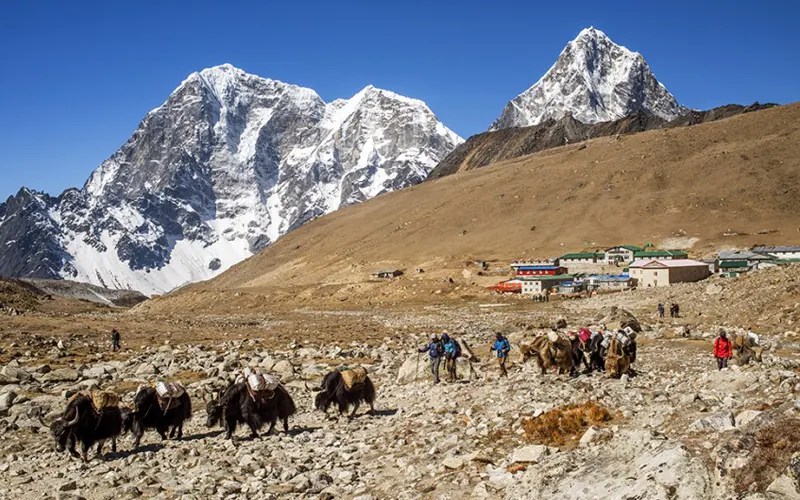
If you want a real highland adventure, the ultimate Everest Three High Passes trek is probably the very best bet. Dramatic, big, and adventurous is how we like to define our 16-day Everest Three High Pass trek that takes you into the less traveled area of the Sagarmatha region.
The trek is not only known for its adventurous experience but also for the bewildering nature along the route that goes unnoticed by travelers on the Everest trail. The breathtaking nature along the path can captivate the heart of any individual taking you away into the peaceful realm you have never experienced anywhere.
Thus the Everest Three High Passes Trek is the most complete option possible that takes you not only to the Khumbu Valley but also goes deeper into less visited Gokyo and Bhote Koshi Valleys. Along the route, you will cross the three high mountain Passes of more than 5000 m: the Kongma La at 5535 m, the Cho La at 5420 m, and the Renjo La at 5360 m.
You will cross the passes in the counterclockwise path which is easier than its clockwise counterpart. Additionally, you will live the commemorative experience upon arriving at Everest Base Camp, reach the summit of Kala Patthar, and sleep next to the amazing Gokyo Lake, one of the most important in the Himalayas. We will also explore the lakes of Gokyo and visit the religious shrine next to its shore.
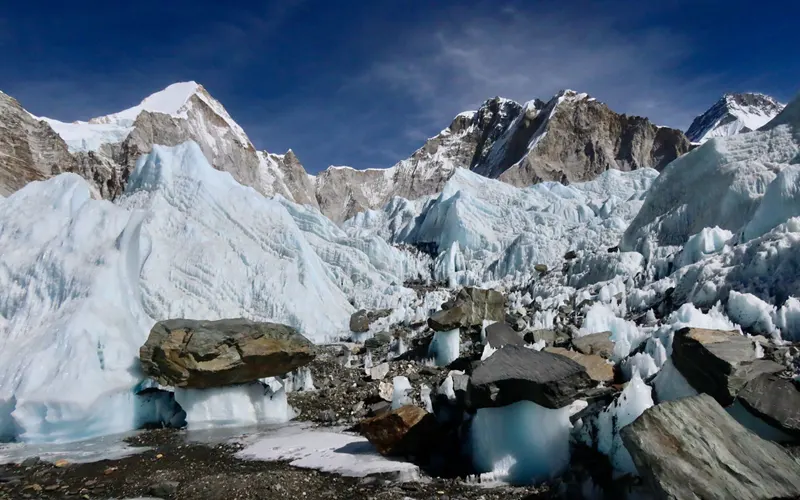
Throughout the Everest three high passes trek, you will also experience daily the impressive views that the Himalayas offer us from its highest lands. You will walk on a glacier and get to know up close the daily life of the typical Sherpa settlements in the Khumbu region and you will feel the warm welcome of its people.
In terms of level of challenge, the Everest three high passes trek is one of the difficult trek that requires previous experience in trekking or hiking. Therefore you should be in good physical shape because during the tour you will experience high altitude conditions where your physical abilities will be tested to their limit.
Although this journey can be done on other dates, the most favorable times are during the months of March, April, May, and later, in September, October, and November.
Like all the other trekking adventures in Khumbu, our Everest three high passes trek also begins with a short flight to Lukla from where the hike starts to Phakding. Then traversing the charming settlements of Namche, Tengboche, and Dingbcohe, you will direct your steps toward Chhukung Village and cross the Kongma La Pass.
Then descending to Lobuche, you will reach Everest Base Camp and climb Kala Patthar from where you will descend to Bhote Koshi Valley, cross the Cho La Pass, and march to Gokyo Valley.
From Gokyo, you will move on to cross the Renjo La Pass and retrace through Lungden, Thame to Namche and Lukla.
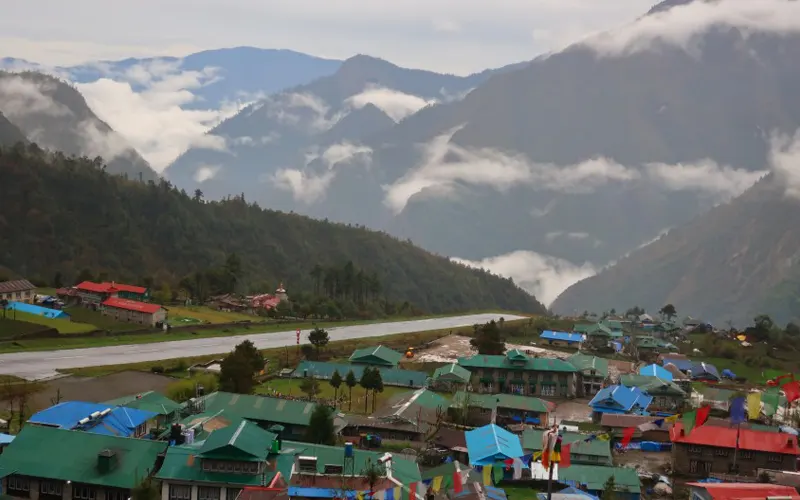
We will have a very early morning breakfast, then, we will drive to Kathmandu airport for an internal 30-minute flight that will take us to a beautiful Sherpa town of Lukla. The views during the flight are spectacular with Everest and Kanchenjunga literally below our feet.
We will land on the steep runway of Lukla airstrip which will be a unique experience. Moreover, the sparkling Kongde Ri Himal (6187 m) peeking through the cloud is more than we can really expect.
After meeting our local team, we will now begin our easy and mostly downhill walk towards Phakding. The path runs along the marvelous Dudh Koshi River past the villages of Chheplung, Chaurikharka, and Thadokoshi. A remarkable sight of Mount Kusum Kangaru (6367m) is truly a sight to behold.
Walking down, we will march to Ghat Village, and shortly thereafter we will reach Phakding with Mount Khumbila (5761 m) constantly gazing upon us.
Attention
In spring and autumn, the Lukla flight often is directed to the Manthali Airstrip in Ramechhap due to the high air traffic load. Therefore, we will drive to Manthali airstrip in Ramechhap for about 4 hours to board a flight to Lukla.

After an early breakfast, we will commence our march to Namche Bazaar- regarded as the commercial center and capital of the Khumbu Valley.
Advancing along the white waters of Dudh Koshi River, the route runs through the beautifully colored rhododendrons and pine forest. The magnetic Thamserku Himal (6609 m) towers against the sky in the northeast.
Shortly, the path takes us to Benkar and then to Monjo Villages. The small Monjo Village acts as the entrance to the Everest National Park. Here, our permits and documents will be inspected. Then, marching forward along the ascending trail, we will arrive at Jorsalle where we will take a small break to eat our lunch.
Proceeding with the journey, we will cross the Dudh Koshi River and after about 30 to 40 minutes, we will arrive at the meeting point of Imja Khola and Nangpo Tsangpo (Bhote Koshi) that run together in Dudh Koshi. Here, we will go out on the most beautiful Hilary Suspension bridge observing Taboche Himal (6495 m) at the distance.
Walking for an hour from the bridge, we will reach the best part of today’s trek: the Everest View Point or Top Danda at 3140 m which offers the incredible scenery of Lhotse, Everest, and Nuptse.
We will then climb for about an hour more upon a zigzag path to reach Namche. We can find a multitude of shops, cafes, banks, and good hotels in the town.

We will spend another night at Namche for favorable acclimatization at an elevation of more than 3000 m. In the morning, we will do a circuit in the area, then climb to the 3880 m high Everest View Hotel from where you can see the dazzling peaks from every room and corner.
The two-hour route climbing to the hotel is equally beautiful awarding us with the grandest visuals of Kongde Ri, Pachhermo Peak, Khangtega, Tangerito Peak, Sumdur Peak, and many more.
The most remarkable breakfast awaits us at the hotel balcony where we have Everest, Ama Dablam, Thamserku, Lhotse, Taboche, Cholatse, and Nuptse in the front and the back.
The rest of the afternoon, we have time to wander around and visit the Namche Market.
Heading towards Tengboche, we will follow a gentle path for about an hour before descending steeply for an hour and a half. After that, we will cross the suspension bridge and proceed through the pine, fir, and rhododendron forest until we reach Phungithanga at 3250 m.
After eating lunch at Phungithanga, we now climb up for about 2 hours to Tengboche monastery. We will get inside the Gumpa, interact with the monks, and see their daily rituals. The monastery also serves as the better vantage point to watch the Everest, Nuptse, Kwangde (6,187 m), Lhotse (8,501 m), Tawachee (6,542 m), Kantega, Ama Dablam, and Thamserku up close.
We will now head to register in our lodge to settle for the night. Notice how the landscape here already changes to the bare rocky sides of the imposing mountain peaks.
The picturesque trail today is decorated with roadside monasteries, colorful prayer flags, and blindingly white stupas. From the lodge, we will ascend for a while to reach Debuche all the while observing the most beautiful profile of Ama Dablam.
Then, we will make our way down and cross a suspension bridge over Imja Khola. Then, we will start our gentle climb towards Pangboche. As we arrive close to the village, we will come across two options: one to the left which goes up the staircase to Upper Pangboche, and one to the right to Lower Pangboche which takes us to Dingbcohe.
We will head right, now the path is pleasant made up of small climbs and descents with many sections practically straight for a long time. We will go down through the small villages of Shomare and Orsho, and reach the riverbank, and cross a small bridge. After crossing, we will begin a gentle climb that will take us to the village of Dingboche.
After leaving Dingboche after breakfast, we will walk to the end of the village and pass some areas of pastures. When this part ends, the trail now goes over the rocky terrain as we begin to approach the Imja Khola River.
Then we will engage in a steady climb alongside the wonderful Ama Dablam and Lhotse. As we get closer to Chhukhung, the path becomes a little more difficult, with a steeper climb, more rocks and frozen water flows to cross.
The village is a base for those who are going to climb Island Peak or for those who are going to Everest Three High Passes. There is a magnificent view of Numbur, Karyolung, Kongde Ri, Cholatse, and Tawache in incredibly beautiful surroundings.
After some rest in the lodge, we can also choose to climb the 5546 m high trekking peak of Chhukung Ri. But the climb to the Peak can be strenuous and long so we suggest you rest in the lodge or explore the village as we have to cross the first pass of Everest the next day.
The day has come to cross our first Pass on our Everest Three high passes trek. We will start very early from our lodge, we will carry our lunch with us as there will be no other facilities along the way.
The path goes directly north towards the Nuptse glacier, from where the Amphu Laptsa pass area slowly comes into view to the south. Above Bibre we will enter the Nyiang valley with Pokalde on one side and Chhukung Ri on the other. It will be a strenous hike at times and there may be snow along the trail.
The trail turns west and does not become less strenuous, but after a good 3-4 hours, a pass of small mountain lakes appears. We are now
between the Pokalde and Kongma Tse mountains and the height of the pass itself, Kongma La 5,535 meters.
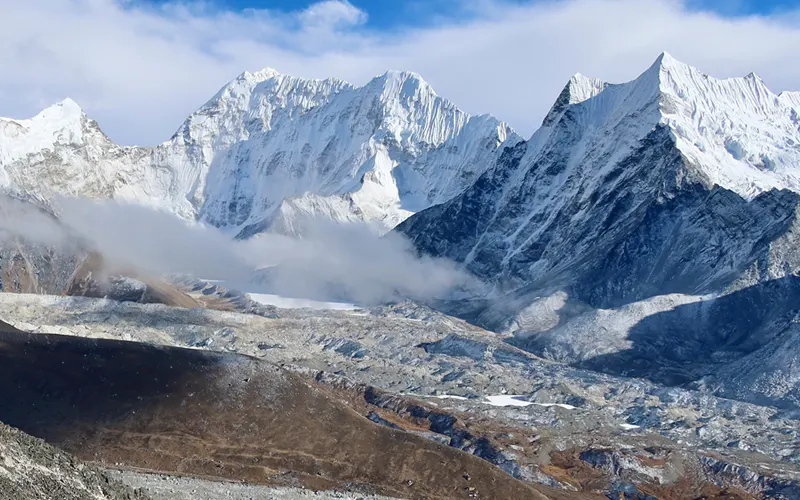
From the Pass, we can observe the dazzling mountain peaks of Lhotse, Makalu, Everest, Pumori, Gauri Shankar, Nuptse, and Ama Dablam. The trail from the pass now descends steeply towards the Khumbu glacier, which we must cross before arriving at Lobuche.
Again rise early in the morning to head to the historical Everest Base Camp. From the lodge at Lobuche, we will climb along the top of the Khumbu Glacier moraine. We will continue walking like this observing the beautiful snowy peaks of Everest, Pumori, Mahalangur, Lingtren, Khumbutse, Nuptse, and other peaks until we reach the Lobuche Pass known locally as Thangmu Riju.
We will then climb up and down several times along with crossing the moraine and the Changri Glacier. The Kala Patthar comes into view slowly as we make progress in our trail.
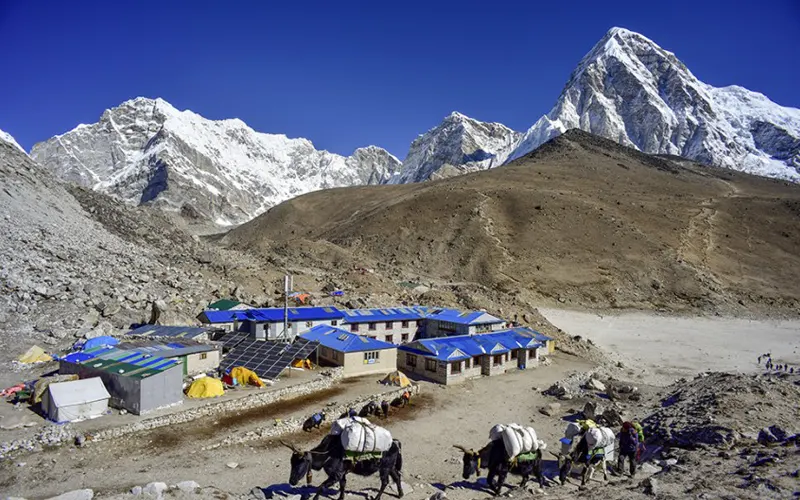
After arriving at the lodge of Gorakshep- the highest last settlement in the Khumbu Valley, we will keep our luggage, rest, and eat.
Then we will proceed towards Everest Base Camp, a 2 and half-hour trail along some ups and downs beside the now dry Gorakshep Lake will take us to the Camp dominated by the Khumbu Glacier, Nuptse, Lhotse, Khumbutse, and Pumori.
After we are satisfied with the sight, we descend back to Gorakshep, where will sleep early to climb the black stone summit the next day.
Another memorable day awaits us! After leaving Gorakshep, we will climb very steeply first till we reach a plateau, where we will walk for a while. We may see some helicopters landing here taking people on tour above the sky.
Then, we will climb again along the rocky path for about half an hour and reach the top of Kala Patthar to meet the sunrise over Everest, Lhotse, Nuptse, Amadablam, Lobuche, Pumori, Lingtren, Khumbutse, Changtse, and many more beautiful peaks.
After taking the Himalayan photos, we will descend back to Gorakshep for a hearty meal. Then we will descend along the foot of the Lobuche massif through Lobuche above Chola Lake. From here, we will turn west towards the settlement of Dzongla as our goal is the deep Gokyo Valley.
The day to cross the second-highest Pass has arrived. Leaving Dzongla, we will climb smoothly through the middle of the valley until we reach some rocky icy area. Then passing a small lake, we will climb a stone staircase and start walking along the glacier.
After we reach the end of the glacier, we will overcome a sharp climb along the rocky wall with the help of attached ropes to reach the top of the Cho La Pass. We will again be in the middle of the astounding Himalayas.
We will now descend from the Pass which can be very steep, there will be ropes attached for an easy climb down. We will now come across another 5100 m high but an easy Pass which we have to climb and descend of course.
The descent will end at the village of Dragnag where we will settle for the night.
Today we have an easy and short day so we will start quite late. Leaving the lodge at Dragnag, we will climb the moraine and cross the Ngozumpa glacier. Already the marvelous views of Kangtega, Cho Oyu, will be sparkling in front of us.
After walking across the metal bridge, we will reach the first Gokyo Lake known by the name of Longponga. Next, the rough dusty road will take us to the second Gokyo lake known as Taujung Lake. At a short distance, the third lake of Gokyo awaits us which is the most attractive known as Dudh Pokhari.
There is also a good hotel at the shore of the lake where we will check in for the night.
The day of our crossing the last pass in the Everest Three High Passes trek has arrived. The Renjo La Pass is the easiest Pass of the three. The climb is relatively easy, the descent is long and steeper, but there are stairs that will help with the task.
Leaving Gokyo, we will walk around the Gokyo Ri hill and then climb towards the Pass. After about 3 to 5 hours, we will arrive at the base of Renjo La Pass from where we will walk in zigzag in a very steep place to reach the top of it. And when you reach the top of the Pass, the view is world-class: Makalu, Cho Oyu, Everest, and the entire Gokyo valley.
After some peaceful time at the Pass, we will now climb down to the Bite Koshi Valley and rest at Lungden.
We have not a long day today and mostly the descent is through the pleasant trail towards Thame. We will climb down to the south in the Bhote Koshi valley towards Marlung village. Slowly the sandy potato fields of Thame will come into view after about 4 to 5 hours.
The Kongde Ri and Tengkangpoche will beam over us as make our way to the village. After registering the the lodge, we may go on to explore the Thame Monastery located quite high above. It is one of the most important monasteries in the Everest area.
The peaceful path mostly downhill will take us to Namche today. On the way, we will pass a monastery of Thamo Village. It is just for women and very remarkable. As we come closer to Namche, we will have to climb a little to reach Namche. You can visit the Irish Pub later in the evening to celebrate your success.
The journey from Namche to Lukla is long but not hard. First, we go down to the beautiful bridge and then check out of Sagarmatha National Park at Jorsalle.
Then we continue through Monjo, Benkar, Phakding, Thadokoshi, Chaurikhark, and Chheplung to Lukla.
Early in the morning we go over to Lukla’s small airport terminal and fly to Kathmandu. The rest of the day is free for your own activities in Kathmandu. The Thamel area is worth an experience with hundreds of shops and restaurants, cafes, and more. In addition, it is recommended to go to Durbar Square and the old town, maybe visit Swayambhunath.


The Autumn season from September to November is the best time for the Everest Three High Pass trek as the season brings an explosion of colors to the Khumbu landscape. It’s a wonderful time for walks, as the forests and mountains along the trail take on orange, red, and yellow.
Cooler temperatures and clear air also make walking pleasant. However, shorter days will approach in the late autumn. Despite this, the way to the passage often clears out of snow making the crossing relatively easier.
Spring from March to May is the second best time for the Everest three high passes trek as it marks the start of a period of renewal and growth, where nature comes to life with blooming flowers and longer, brighter days. It is a time to rediscover the lush landscapes and enjoy gentle walks under a clearing sky.
The heavy downpours in summer months from June to August and the short days and long nights with freezing temperatures in winter from December to February make these two seasons not too favorable among trekkers.
The Everest three high passes trek stretches 166 km in total which we will cover in two weeks with a cumulative elevation gain of around 10000 m. Our journey will take us across three remarkable passes: Kongma La at 5,535 m, Chola Pass at 5,420 m, and Renjo La at 5,360 m. Additionally, we also take a short visit to Everest Base Camp at 5364 m located 200 to 300 km away from Kathmandu.
The highest point of our Everest three high passes trek will be Kala Patthar, which reaches to an impressive elevation of 5,548 m. Our highest overnight stop will be at Gorakshep which offers a maximum elevation of 5,180 m.
During our 16-day itinerary, we will engage in a remarkable hiking adventure for 15 days walking approximately 5 to 7 hours each day, covering a distance of around 11.5 km. Some of the days will be truly spectacular with alluring vistas and easy trails. One such day falls on the 6th day of our trek when we travel from Dingboche to Chhukung village walking only for 2 hours.
On the other hand, some days are hard and laborious yet the reward will be priceless. Two such days fall on the 7th and 8th day of our trek when we will have a longer journey, walking for 8 to 9 hours. On the 7th day, we will cross the most challenging pass of Kongma La and on day 8, we will hike to Everest base camp and return to Gorakshep.
Of all the treks in the Khumbu region, the Everest three high passes trek is considered the most difficult trek. The first challenge we encounter is the arduous hiking along the zigzag path, snowy and rocky trails. Some of these trails may not be marked, making it easy for us to lose our way.
The second difficulty lies in the high altitude we will be trekking with most days leading us above 5000 m. Lastly, we will conquer the three prominent mountain Passes of Everest. Among these passes, Kongma La is the most feared as it is the least crossed pass unlike the Cho La and Renjo La which are most crossed when trekking to Gokyo Valley.
In order to minimize the risk of high altitude, we have planned rest days at Namche and included a short acclimating walk to Chhukung from Dingboche. We have also shortened our walking duration after crossing the Cho La Pass and progressing towards Gokyo Valley.
The Everest Three High Pass trek is undoubtedly one of the toughest treks in Nepal that is known for offering some of incredible moments along with spellbinding vistas. But, you will be traversing not one not two but three high Mountain Passes that are above 5000 m elevation.
Along with the Passes, you will also travel to step into the legendary Everest Base Camp and ascend the majestic yet high Black summit of Kala Patthar.
The long day of strenuous hikes, some steep ascents followed by the sharp descent are the characteristic of this trek. Therefore, this trek is a true test of your physical fitness, mental strength, and determination.
If you possess all these qualities along with a great passion for conquering heights and experiencing the majestic nature of Gokyo, then yes, this trek is for you even if you are new to trekking. However, we do suggest you prepare and train yourself before undertaking this remarkable journey in Nepal.
The Everest three high passes trek is no ordinary trek and it is no ordinary journey. Therefore, your preparation should also not be ordinary. Please start preparing yourself at home at least 3 months before your trip. Concentrate on aerobic exercises that can build up your endurance and stamina.
Good exercise for the hikers to prepare for the long day hikes includes climbing stairs, walking (with or without weight and on a slope), or using fitness equipment (stair climber, incline treadmill, elliptical trainer, or stepmill).
Our approach to the great Everest three high pass is counterclockwise direction which provides the opportunity for gradual acclimatization during the trek. However, we can also approach the Everest Three passes in a clockwise direction which is a better option for those who are well-prepared and have some experience in high-altitude trekking.
This route first takes you through the easiest pass among the three: the Renjo la Pass and then to Gokyo Valley. Then you will move on to cross the Cho La Pass tackling the difficult Pass of Kongma La at the end.
The route starts from Lukla taking you to Namche Bazaar from where you will direct your step toward Thame, and overcome the Renjo La. You will then advance to Gokyo and march forward to conquer the Cho La Pass. From here you will set foot in Everest Base Camp and climb Kala Patthar. Then you will tackle the Kongma La Pass and march back to Namche.
Moving to an altitude above 3000 m in just a few days can really take a toll on your body. The dry, oxygen-deficient air in Khumbu requires your body to adjust gradually. Acclimatization is key here, giving your body the time it needs to get used to the high altitude.
Despite all the preparation, altitude sickness can still affect some people, leading to symptoms like nausea, headaches, dizziness, insomnia, breathing problems, and loss of appetite. To prevent these symptoms, stay hydrated, move slowly, and avoid rushing. If you experience any of these signs or feel unwell, notify our guide immediately.
He may offer you Diamox, which can help relieve the symptoms within a few hours. If the symptoms persist even after taking the medication, you may have to descend to a lower height until your condition improves.
After you book your trip with us, all you have to do is sit back, relax, and let us handle everything for you. From your Kathmandu-Lukla-Kathmandu flight to airport transfers, we have got you covered. During the high trekking season of autumn and spring, the flights to and from Lukla will depart from Ramechhap airport. In that case, we will take you to Ramechhap Airstrip on private transport.
As for accommodation and meals, you will stay in the best lodges or teahouses available along the route. Each day, you can enjoy breakfast, lunch, and dinner with a cup of hot tea or coffee and fresh fruit every night after dinner.
You can enjoy a variety of dishes such as toast, Tibetan bread, omelets, pancakes, porridge, soups, momo dumplings, fried chow mien noodles, potato pancakes, baked potatoes, fried rice, and the dal bhat – rice, and many more.
The NCELL and NTC networks work properly in almost all the villages en route. But the signal can be weak or nil at the high Passes. These local networks also provide the 4G service with various options for internet data packages.
The mountain shelters along the route also provide WIFI connections at the cost of 2 to 3 US Dollars per hour. You can also purchase the Everest Link Wifi prepaid cards instead.
Villages have a continuous electricity supply so you can charge your devices. Please keep in mind that services may be complimentary at lower altitudes, but additional charges may apply as you reach higher altitudes.
The Khumbu-Pasang Lhamu village municipality fee and Sagarmatha National Park entrance fee are required for the Everest three high passes trek. Our guide will secure these permits on your behalf at the border of Lukla town.
We have designed our itinerary based on the counterclockwise direction approaching the fearful Kongma La Pass first. This allows us better acclimatization along the route. The clockwise route approaches the Renjo La Pass first which is considered the simple pass among the three. But this route needs a lot of climbing and tackling some steep ascents and descents. Therefore this option is favorable for more experienced hikers.
Yes, you can directly approach the Renjo La Pass and visit the Gokyo Valley then tackle the Cho La Pass.
Yes, you can climb the easy 5361 m high Sumdur Peak located in Thame Valley.
Yes, you can stay in Pangbcohe for two days and take a detour to Ama Dablam Base Camp. Or, you can stay two days at Chhukung village and climb the Chhukung Ri Peak. Tengboche can also be another option to spend a few delightful days in the Khumbu Valley.
If this happens, you will be left with a Sherpa helper to acclimatize longer in the place or descend in altitude, and you will join the group a few days later.
1780 US$
Total Cost:
US$ 1950




 Write a Review


