


Island Peak Climbing
5/5 based on 05 reviews

Trip Duration
13 Days
Group Sizes
10
Transportation
Private Vehicle & Flights
Destination
Nepal
Max. Altitude
6160m
Best Season
Mar- May , Sep- Nov
Activities
Trekking/Climbing

Difficulty
Challenging
Meals
Inclusive

Start & End Point
Kathmandu
Accommodation
Hotel/Tea house
Do you wish to experience the whole new world and get acquainted with the big mountain towering above 6000 m altitude? Without a doubt, the answer must be yes! So we welcome you on our 13-day Island Peak climbing expedition which is a symbiosis of trekking and climbing the beautiful Island summit imposing at an altitude of 6165 m above sea level.
Our Island Peak climbing has it all: wide valleys in a deep gorge, ancient glaciers turning into turbulent rivers, steep mountain walls, explosive flowering of alpine meadows, and curious mountains peeking out from behind the stone.
And, above this incredible world of pristine nature emerges the majestic beauty of the Island peak. It rises like an island in a sea of glaciers in the southern part of the Lhotse Shar range in the epicenter of the Khumbu region.
The Peak is itself a model of serene beauty blessing all its visitors with the sensational views of Nuptse, Lhotse Shar, Lhotse, Ama Dablam, Makalu, Everest, and several other dazzling peaks.
Walled by the Baruntse Himal on the south and Nuptse and Lhotse on the north, the peak was christened Island Peak in 1953 by a true explorer named Eric Shipton. The expedition he led with Charles Evans, Alf Gregory, Charles Wylie, Tenzing Norgay, and other 7 Sherpas triumphantly climbed the Peak in the same year.
Aspired by these legendary climbers, we have designed our Island Peak climbing tour that will not only give us the extra dose of mountains and views every day but also the opportunity to visit several climatic zones at once.
We will also walk through numerous mountain villages, Buddhist stupas, prayer flags, and snow caps along with the smiles of Sherpas, the ringing of the Yak bells, with monks playing volleyball. The tour is overall the gigabytes of impressions and new neural connections.
Categorized as moderate in difficulty level, Island Peak climbing requires the climbers to have good physical fitness and skills in working with a jumar and a rope.
Overall, the Island Peak climbing tour is an opportunity to fulfill the dream of those who are looking for an exciting adventure and want to expand their mountaineering experience.
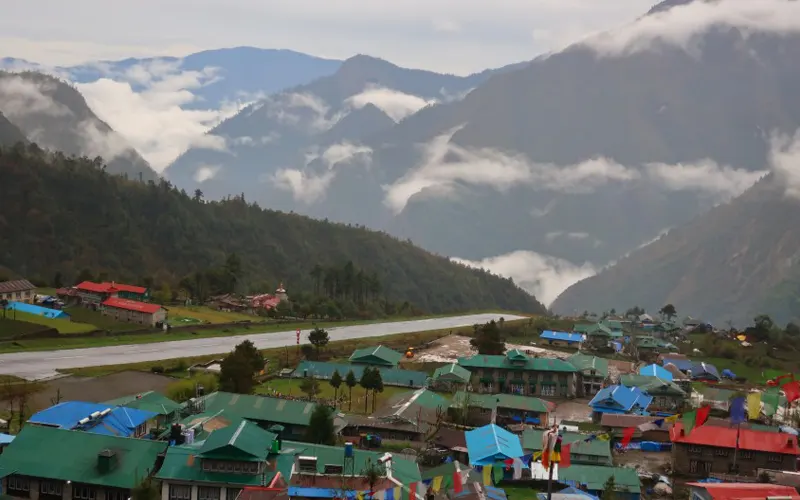
The Island peak climb commences with a short flight to the 2800 m high Sherpa town known as Lukla. We will then make our trekking starting from the airstrip in Lukla, along the path through the gorge of the Dudh Koshi River to Namche Bazaar – the city of the Sherpas.
Following Tengbcohe and Dingboche, we will divert our feet towards Chhukung which will direct us to Island Peak Base Camp. After assaulting the summit, we will spend the night in Chhukung once again from where we will descend to Phortse.
The trail will now be familiar taking us towards Namche and Lukla. Once again, our journey culminates with an aerial travel to Kathmandu in a small plane.
Our first day of Island Peak climbing starts early in the morning as we drive from our hotel to TIA. After going through the formalities, we will hop on a small plane to fly over Everest, Makalu, Kanchenjunga, and numerous other snowy pyramids to reach the feared Lukla Airport.
Our accompanying team of local members with big smiles on their faces welcome us at the small airport. The first Himalaya of 6187 m high Mount Kongde Ri will please our eyes.
After we eat our breakfast in the nearby lodge, our trekking part now begins. The walk is pretty easy with a few ups and downs along the gentle but picturesque path. Walking to the edge of Lukla town, our permits will be obtained, then the road passes through the tiny Sherpa villages of Chheplung, Chaurikharka, and Thadokoshi. It’s a real delight to see the white faces of Khumbila Himal at 5761 m, and Kusum Kangaru (6367m).
The first suspension bridge greets us allowing us to cross the Thadokoshi river. Next, the road crosses alongside the huge rock boulders where we can see the OM MANE PADME HUM carved on them.
The path now runs downhill gently towards Ghat. The Dudh Koshi River glistens along the way urging us to walk on its eastern bank to reach the ancestral village of Phakding.
Key Points to Remember
We may have to drive to Manthali Domestic Airport located in Ramechhap town in the spring and autumn months to fly to Lukla. Due to the busy season, the TIA will be congested and not to make our guests wait for days to fly to Lukla, the domestic flight is often diverted to Ramechhap. The town is just 4 hours away from Kathmandu.


After enjoying the delightful morning breakfast amidst the mountains, we will walk through the densely grown rhododendron, conifer, and pine forests to reach Benkar. Not to mention, the Thamserku (6608 m), and Kongde Ri sparkling in the sun will keep us company.
We will encounter numerous small rickety bridges along the route and finally we will be at the central entrance of Everest/ Sagarmatha National Park at Monjo. The path now ascends steadily to Jorsalle where one of the tea houses will be our stop to eat our lunch.
Marching further for about 30 to 45 minutes, we will arrive at the merging point of the Dudh Koshi and Bhote Koshi rivers over which the iconic Hilary bridge has been built. Walking across the bridge with the view of sacred view of Taboche Himal (6495 m) is truly a remarkable experience.
Then the path climbs up for about 60 minutes towards Top Danda. Towering at 3140 m, this outstanding Viewpoint is more commonly known as Everest Viewpoint. The site offers extraordinary first views of Nuptse, Everest, and Lhotse mountains.
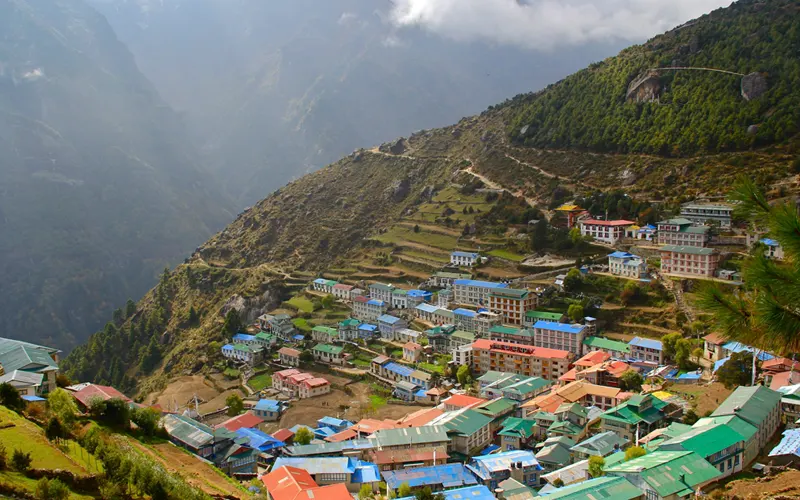
From this point, the path climbs up sharply till we step foot in the central town of Namche Bazaar through which all the expedition to Khumbu Himal runs. It’s a pretty village to spend two nights consecutively.
Breathing the fresh Himalayan air of Kangtega, Lhotse, Everest, and Nuptse, we will eat our breakfast in our lodge. We will then go for a short acclimating walk towards the highest altitude hotel of Everest View. The 2 to 3-hour ascending route opens up the incredible visuals of Pachermo Peak, Kongde Ri, Tangerito Peak, Kangtega, and Samdo Peak.
The stair climb to the hotel through the conifer forest will take us to the beautiful terrace of the hotel. Lunch here is pretty simple but the views are priceless. Ama Dablam for the first time will smile at us while the white stone walls of Everest, Taboche, Lhotse, Thamserku, Nuptse, and Cholatse once more wave us.
Descending to our accommodation is easy and pleasant which can be done with meeting the Sherpas and small children.
The route from Namche now ascends for a while alongside the Dudh Koshi River. Now, it climbs downward through the forest of fir, blue pine, rhododendron, magnolia, and birch towards the small bridge. We will walk over the steel bridge to step into the Imja Valley.
The road now gently climbs towards 3260 m high Phungi Thanga. After almost two hours of climbing, we will be at Tengboche monastery which provides a unique perspective of Everest, Lhotse, Ama Dablam, Thamserku, and Kwangde Peak.
There are small lodges in this wonderful village where we will stop to spend the night.
From Tengbcohe, we will have a pleasant descent through a fir forest, thickets of juniper and rhododendron towards Debuche. Ama Dablam sparkles showing us its glorified face. Once again a small metal hanging bridge will lead us over the Imja Khola. The path gradually climbs towards Pangboche elevated at 3900 m. The village also accommodates a well-known ancient monastery from where the Yeti Scalp was once stolen.
The colorful greenery of the landscape will now be replaced by brown earth and gray stones. The first glimpse of Island Peak in the distance will make our hearts skip a beat. Admiring Ama Dablam and Lhotse, we will slowly climb to Dingboche passing Shomare village on the way.
Dingboche has many small, colorful fields with crops of barley, buckwheat, and potatoes. The fields are surrounded by peculiar stone walls that protect them from winds and attacks from wild animals.
The fresh Khumbu air wakes us up early in the morning. After enjoying the tasty breakfast, we will march from our lodge towards the famous Nagarjun/Nangkartshang Hill. The climbing journey will be about three hours along the decorated path by Manis and numerous stupas.
What a Viewpoint! Island Peak, Ama Dablam, Makalu, Chopola, Baruntse, Thamserku, Taboche, Lobuche, Cholatse, Khankaru, Nirukhang, and several other peaks encircle us from all around.
After some clicking, we will now walk back down to our lodge to rest our tired legs.
Relatively a small journey is stored us for today. With the first rays of the sun, we will exit the lodge in Dingboche and turn east walking along the stream and near the moraines of the Imja and Lhotse glaciers. In about 2 hours, Chhukung Village welcomes us with cosmic views of Lhotse, Island Peak, and Ama Dablam.
After restoring our energy, we can either go for a radial walk towards Chhukung Ri at 5546 m. The climb will last 3 to 4 hours only with the amazing vistas of Nuptse, Makalu, Island Peak, and Ama Dablam in front.
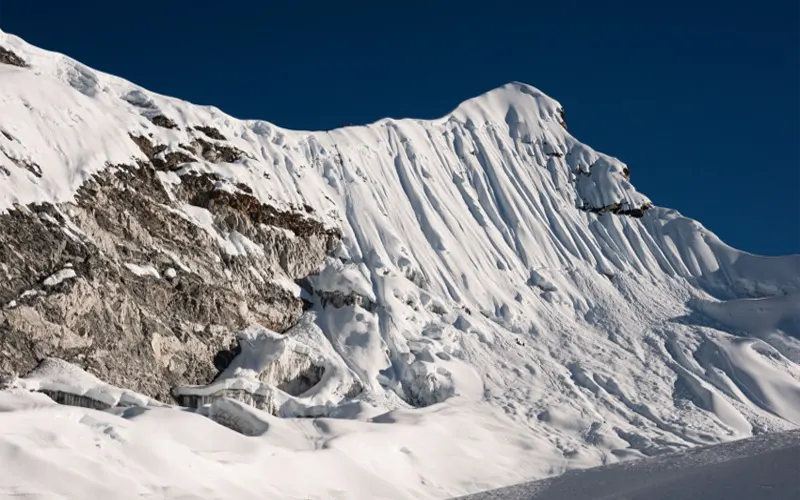
We are one more day behind assaulting the Island summit. With renewed energy, we will leave Chhukung and turn south from where the stony road climbs up sharply towards the east. Then, walking beside the Lhotse and Imja Glacier walls, we will reach a wide valley placed in front of the southwest face of the Island summit.
Shortly, our site greets us where we will establish the tents. From the tents, we can have excellent views of the southwestern slope of Island Peak.
It’s time to check our equipment, and gear: crampons, jumar, harness, ice axe, and climbing boots. Our skilled and friendly climbing guide will teach us the mountaineering skills we need to push the summit. Occasionally, ropes may be needed as well so we will also learn to tie knots and walk up and down in teams along the fixed ropes.
A very important day of our Island Peak climbing expedition has arrived. Waking up early at around 2 am, we will eat a light breakfast in our tents, then clothing with warm attire and gear up with the equipment, we will get ready to leave our camp. With all the group members together, we will head to the left side and climb sharply for about 800 m along the rock terrain.
The trail follows the loose sandy terrain for a while leading to the High Camp of Island Peak. From here, the trail will be on ice and rocks that climb for about three hours. We are now in front of the glacier, it is time to put on our crampons.
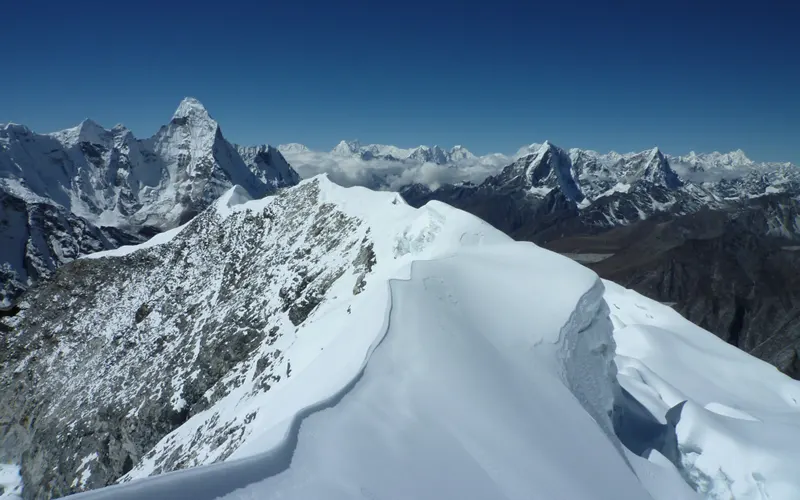
Having passed along the glacier, we will come out to the wall of Island Peak, fasten ourselves into the railings, and climb to the top along a steep snowy slope inclined to a 35 to 45-degree angle. We will use Jumar to cross the section.
Here we are, at the tip of the summit where we will carry out an enthusiastic photo session of Makalu, Ama Dablam, Lhotse, Baruntse, Cholatse, Everest, Thamserku, Pumori, and many more illuminating peaks. Then we will descend along the railings to the base camp for some rest and an energizing hot meal.
We will then disarrange our tents and march down to the warm lodge of Chhukung village.
What a wonderful morning after a successful reach to the summit! It’s time now to make a descent through the Sherpa villages once more to return to the urban environment of the capital. After breakfast, the trail from Chhukung mostly runs downhill and sometimes climbs up gently leading us through the Imja Khola towards Shomare and Orsho.
The similar sight of Pangboche is pleasing as we pass by its old monastery once again to reach Phortse.
We will slowly descend lower and lower into the kingdom of green rhododendrons. Leaving the Imja Valley, we will step again into the Dudh Koshi River Valley.
After walking down for about 2 hours and hiking across the steel bridge, we will reach Phortse Thanga. Climbing up steadily for about half an hour, the trail takes us to the top of Mongla Danda towering at 3973 m. The wide Valley of Khumbu from the Pass is unrecognizable while the peaks of Cholatse and Taboche shine behind.
Now, we will again descend for about 1 to 2 hours towards Sanasa village to reach the warm settlement and comfort of Namche.
Descending down through the green realm of pine, fir, and rhododendrons, we will walk past Jorsalle, Monjo, Benkar, Phakding, Thadokoshi, Chaurikharka, and Chheplung to reach Lukla town- site from where our trek began and ends.
Today morning will give us another opportunity to fly from the fearsome Lukla Airstrip towards the low plain of Kathmandu. In the hotel, we can take a relaxing hot shower and taste some cuisine different from what we ate during the trek. The second half of the day is free – you can relax and buy souvenirs.


The autumn (September to November) in the Himalayas is a great time for climbing and trekking as the hot humid days of summer subsides, bringing the cool air with moderate temperature between 5 to 15 degree Celsius. The forest turns into fierce orange and yellow with the most beautiful and clear views of the high Himalayas.
The spring (March to May) is another excellent time to open a window for Island Peak climbing. The months provide a great opportunity to see the lush Himalayan fauna at the moment of nature’s awakening with a mild temperature of 16 to 17 degrees Celsius. Nature turns pink and green, and the cold air is slowly replaced by the warm dry air.
The summer (June to August) brings in a period of heavy rain, and humid and wet days, with a high probability of leech and mosquito infestation. The winter (December to January) yields very cold weather with minus temperatures even during the day. The snow covers the trails and gorges, the camps are coated with thick ice and snow making the stay in the tent quite problematic.
The adventurous journey of Island peak climbing covers a total distance of about 150 km. The Peak is situated 160 km away from Kathmandu and 41 km from Lukla.
Speaking of Lukla, it is tucked away at an aerial distance of 137 km from Nepal’s capital Kathmandu. As you ascend, the summit itself awaits you at the staggering elevation of 6165 m while the highest overnight stop will be at the Island Peak Base Camp elevated at 5200 m above sea level.
Throughout the 13-day journey, you will be covering a distance of 10 to 12 km on foot each day.
During the 13-day Island Peak climbing expedition, we will be hiking for 12 days, with each day averaging about 5 to 7 hours. This includes a necessary acclimatization walk between the trek and the summit climbing day.
The trail is generally comfortable, winding through forests and alongside rivers. However, the journey to the base camp and the summit can be quite demanding, with rocky paths and glacial terrain. That’s why the duration of our daily walks varies.
The shortest walking day falls on day 7, as we make a 2-hour trip from Dingboche to Chhukung. On the other hand, the longest walking day falls on day 9, when we ascend to the summit from the base camp and then hike down to Chhukung village, which takes approximately 9 to 10 hours.
The Island Peak is graded 2B according to the alpine grading system which means the climbers have to tackle the long simple rocky areas and hollow ice. In addition, there will be short rock walls and ice areas with a steepness of up to 50°.
Technically speaking, the peak is most difficult in comparison to Mera Peak. Because, on the way to climb the summit of the Island, you have to use a jumar and a descender, since you need to go to the summit ridge along the railings for about 200 meters and 150 meters of altitude gain.
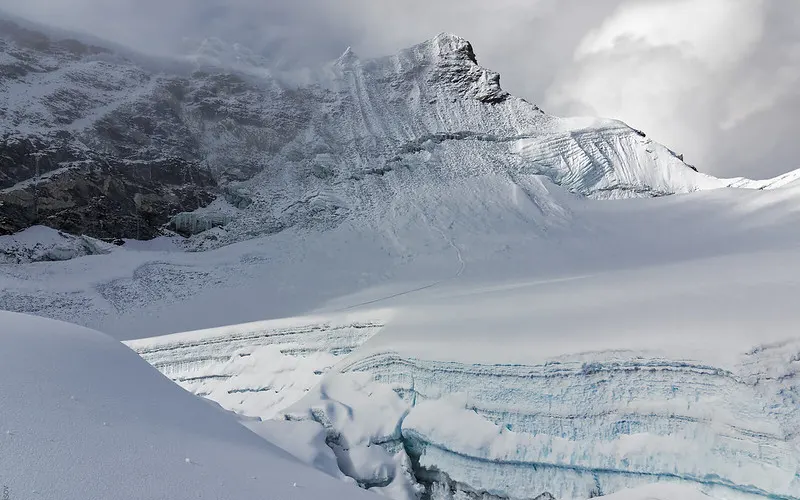
And, the Island Peak glacier itself is quite jagged, it has changed, and has become very crooked, and in some areas, it has even become somewhat similar to the Khumbu glacier. There are also ladders and railings installed there. Yes, it is exciting and interesting but it is dangerous.
Therefore, the Island Peak climbing is suitable for people for whom mountains are not just a romantic adventure, but an important part of their lives. Feel free to choose the route if you have experience climbing mountains from 4 thousand meters, and have training in rock climbing.
In order to reduce the potential risks and increase the chances of reaching to the summit, our ascent program program provides for gradual acclimatization with a smooth climb and includes one acclimating day at Namche Bazaar and another break in Dingboche.
Island Peak climbing is a suitable option for beginner climbers who have already ascended 4000 m or 5000 m mountains, hills, Passes, or ridges. However, the basic skills in mountaineering and climbing are important when attacking the Island summit. It means you should have some knowledge and some idea is walking with crampons, and working with ice axes, jumar, harnesses, and ropes.
However, do not fret if you don’t have the skill as our experienced and well-trained guide will give you some training sessions before assaulting the peak in the base camp. Besides, you will be accompanied by other group members and our guide will be constantly by your side.
An important note to remember is here we are referring to new climbers and not new hikers. If you have not undertaken any high-altitude trekking before and this is your first time venturing into Nepal, we suggest you not attempt mountain climbing right away.
Instead, go for an easy high-altitude hiking journey to Annapurna Base Camp, Everest Base Camp, or Ghorepani and Poon Hill. This will allow you to familiarize yourself with the environment, risks, and difficulties associated with hiking along the Nepali terrain.
The Nepali landscape differs significantly from your home terrain, as the flat trail here means the trail with quite ups and downs.
Even if Island Peak is a beginner-friendly peak, and rises to 6000 m, you should still be thoroughly prepared so that you can act and react correctly in any situation. Overestimating yourself can often result in some trouble.
Therefore, it is important to gradually prepare for Island Peak climbing. That means you should know your own physical abilities and limits first. Then you can slowly train and increase your physical preparation.
It is useful to take every opportunity to at least go on short hikes or mountain tours, or go to the climbing gym if the weather is bad.
On the other hand, endurance is most important in high mountain tours where pace matters more than speed. That’s why, do endurance exercise at a moderate pace a few times a week, for example, while jogging, running, biking, walking, and squatting.
And if physical preparation is significant so is the mental preparation that can help you get into a positive spiral of thinking and thus enjoy the mountain tour more and at all stages. Yoga and meditation help with building a positive mindset.
According to our itinerary, we will approach the Island Summit from its south ridge. This route is more common and relatively easier. As an alternate option, the peak can also be approached from its northern ridge. However, his route is more technical as it involves glacial crossing above Imja and Lhotse Shar, ice climbing, overcoming the crevasses, steep slopes, and seracs.
This route was first successfully attempted by Alf Gregory, Dick Cook, and a few other Sherpas in 1958.
On the other hand, you can also make the common route to Island Peak even more exciting by combining the Everest Base Camp and ascension to Kala Patthar. After reaching Dingboche, your next destination will be Lobuche, from where you will trek to the base camp of Everest.
The next day, you will summit Kala Patthar and return to Dingboche. From here, you will follow the same trail we have designed for you.
While walking at altitudes above 3000m above sea level, there is always the threat of altitude sickness. Therefore, before starting your hike for the day, we recommend you hydrate yourself by drinking at least 500 ml to 1 lt. water. Then, carry the water in your backpack for the rest of the journey.
Apart from water, it is also important to maintain the balance of fluids, electrolytes, and sugar in the body. If one of these three things is missing, then the physical symptoms of altitude sickness begin to appear. Such as fatigue, muscle spasms, blurred vision, headache, and irritability. Therefore, along with water, carry some salty snacks and dry fruit for the way.
If any of these physical conditions appear, please do not forget to inform our climbing guide. He is well-trained to handle such conditions and will give you Diamox or Ibuprofen according to your condition.
If the symptoms still do not disappear within a few hours, he may postpone your tour and take you to a lower height for proper acclimatization.
We are committed to providing you with a complete service for each trip you book with us, and the Island Peak climbing tour is no exception. We will organize a round-trip flight from Lukla to Kathmandu at the start of the journey, as well as a return flight at the end.
Private transport will pick you up from your hotel to take you to TIA, and the same service will be provided when taking you from TIA back to your hotel in Kathmandu. In the event of a diversion to Ramechhap, a private car or jeep will transport you to the domestic airport for a flight to Lukla.
We will also take care of your accommodation, meals, and drinks throughout the trip. You will sleep in the finest lodge available in the overnight villages along the route. At the overnight lodge, breakfast and dinner with tea or coffee will be provided, and along the route at the tea house, lunch will be served. Fresh seasonal fruits will also be provided after dinner.
The lodge menu offers a diverse range of options, including typical Dal Vat and Tarkari, as well as pasta, pizza, momos, pastries, noodles, and ethnic Tibetan cuisines such as Tibetan Thukpa, bread, stew, and more.
During tent accommodation at the base camp, tents, mattresses, and kitchen utensils will be provided by our company, and our team will set up the camp and cook meals for you.
Namaste and NCELL are the two major mobile networks in Nepal, offering coverage across the nation. In Kathmandu, you can secure their SIM cards easily with the presentation of a copy of your passport and the cost is very minimal.
These networks also offer 4G services for fast internet connections that work well in most villages, except at base camp and the summit. While lodges along the route provide WIFI, the speed may vary, but it is sufficient for communication through apps like WhatsApp and posting photos on Instagram.
Everest Link WIFI is accessible along the trail and even functions at the base camp in clear weather. Prepaid cards for this WIFI can be purchased at the lodges. Additionally, lodges offer charging facilities for your devices, including mobile phones, cameras, and power banks. Please kindly note that the cost of WIFI and charging devices are not covered by our service.
To climb Island Peak, we need to obtain an Island Peak climbing permit from the Nepal Mountaineering Association (NMA), as well as make a $500 garbage deposit to the NMA in Kathmandu.
Additionally, we need to acquire a Sagarmatha National Park permit and a local area permit for the Khumbu rural municipality in Lukla. Our guide will take care of securing all these permits on your behalf, and the cost is already included in our Island Peak climbing package.
Yes, travel insurance is mandatory when climbing Island Peak, and you have to submit us a copy of your insurance policy after you book our trip. In addition, the climbing permit will not be issued to those who don’t have insurance. We strongly recommend you have a policy that includes personal liability, cancellation, emergency helicopter rescue, dismemberment, and loss of luggage or personal effects.
Climbing permits for peaks in Nepal are restricted by the NMA to control the number of climbers and reduce environmental impact. If you are unable to secure a permit for Island Peak, you may consider attempting Mera Peak or Lobuche Peak instead, as they are also 6000m trekking peaks similar to Island Summit.
The Island Peak climbing tour includes a long walk through villages, which allows us to be sheltered whenever necessary. In addition to experiencing Sherpa and Nepalese culture throughout the trek, we will also be well supplied with food, accommodation, and the minimum necessary structure. It is a place where we will have many rest and escape routes.
Yes, but you will have to pay the difference in price for the room you choose.
Throughout the walk, we will find many different types of bathrooms. There are lodges that already offer private bathrooms with toilets and in higher remote villages, we will have a common toilet outside the lodge to be shared with fellow travelers. We will use the lodges with external toilets less as much as possible. Modern lodges with private bathrooms are growing more nowadays. The bathrooms are generally clean and nowadays almost all lodges have a hot shower.
2150 US$
Total Cost:
US$ 2350




 Write a Review


